1. Material Fundamentals and Microstructural Qualities of Alumina Ceramics
1.1 Make-up, Pureness Grades, and Crystallographic Characteristic
(Alumina Ceramic Wear Liners)
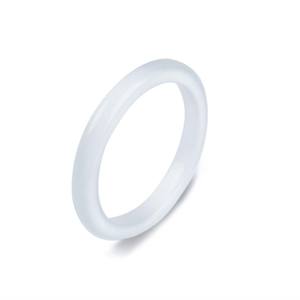
Alumina (Al ₂ O TWO), or aluminum oxide, is just one of the most extensively utilized technological porcelains in commercial engineering due to its exceptional balance of mechanical strength, chemical security, and cost-effectiveness.
When engineered into wear linings, alumina ceramics are typically produced with purity degrees ranging from 85% to 99.9%, with greater pureness representing boosted hardness, put on resistance, and thermal performance.
The leading crystalline phase is alpha-alumina, which embraces a hexagonal close-packed (HCP) structure defined by solid ionic and covalent bonding, adding to its high melting factor (~ 2072 ° C )and low thermal conductivity.
Microstructurally, alumina porcelains consist of penalty, equiaxed grains whose size and circulation are controlled throughout sintering to enhance mechanical buildings.
Grain dimensions typically range from submicron to a number of micrometers, with finer grains typically improving crack toughness and resistance to break breeding under unpleasant loading.
Small additives such as magnesium oxide (MgO) are often introduced in trace amounts to prevent irregular grain growth during high-temperature sintering, making certain uniform microstructure and dimensional stability.
The resulting material shows a Vickers firmness of 1500– 2000 HV, considerably surpassing that of set steel (commonly 600– 800 HV), making it remarkably immune to surface deterioration in high-wear atmospheres.
1.2 Mechanical and Thermal Performance in Industrial Issues
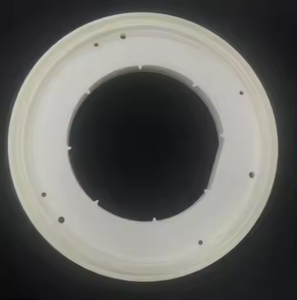
Alumina ceramic wear liners are selected largely for their impressive resistance to rough, abrasive, and gliding wear devices common in bulk product dealing with systems.
They have high compressive strength (as much as 3000 MPa), great flexural toughness (300– 500 MPa), and exceptional rigidity (Young’s modulus of ~ 380 Grade point average), allowing them to hold up against extreme mechanical loading without plastic deformation.
Although inherently fragile contrasted to metals, their low coefficient of rubbing and high surface firmness lessen fragment adhesion and reduce wear prices by orders of size relative to steel or polymer-based options.
Thermally, alumina maintains structural stability as much as 1600 ° C in oxidizing atmospheres, allowing usage in high-temperature handling settings such as kiln feed systems, boiler ducting, and pyroprocessing equipment.
( Alumina Ceramic Wear Liners)
Its reduced thermal growth coefficient (~ 8 × 10 ⁻⁶/ K) adds to dimensional security during thermal biking, minimizing the risk of cracking because of thermal shock when effectively installed.
Additionally, alumina is electrically protecting and chemically inert to many acids, antacid, and solvents, making it ideal for harsh environments where metal linings would break down quickly.
These combined residential or commercial properties make alumina ceramics perfect for shielding important infrastructure in mining, power generation, cement production, and chemical processing industries.
2. Production Processes and Design Combination Methods
2.1 Forming, Sintering, and Quality Assurance Protocols
The manufacturing of alumina ceramic wear liners entails a sequence of accuracy manufacturing steps designed to attain high density, marginal porosity, and constant mechanical efficiency.
Raw alumina powders are processed through milling, granulation, and developing strategies such as completely dry pressing, isostatic pushing, or extrusion, depending upon the desired geometry– floor tiles, plates, pipes, or custom-shaped sectors.
Eco-friendly bodies are after that sintered at temperatures between 1500 ° C and 1700 ° C in air, promoting densification via solid-state diffusion and achieving loved one densities going beyond 95%, usually coming close to 99% of academic density.
Full densification is essential, as residual porosity works as stress concentrators and increases wear and fracture under solution problems.
Post-sintering procedures may consist of diamond grinding or lapping to attain limited dimensional resistances and smooth surface area finishes that reduce rubbing and fragment trapping.
Each batch goes through strenuous quality control, consisting of X-ray diffraction (XRD) for phase analysis, scanning electron microscopy (SEM) for microstructural analysis, and hardness and bend screening to verify compliance with international requirements such as ISO 6474 or ASTM B407.
2.2 Mounting Methods and System Compatibility Factors To Consider
Effective integration of alumina wear liners right into industrial tools calls for careful interest to mechanical accessory and thermal development compatibility.
Usual setup methods consist of glue bonding using high-strength ceramic epoxies, mechanical fastening with studs or anchors, and embedding within castable refractory matrices.
Glue bonding is extensively utilized for flat or gently rounded surfaces, giving uniform stress and anxiety distribution and vibration damping, while stud-mounted systems permit easy substitute and are liked in high-impact areas.
To suit differential thermal growth in between alumina and metal substratums (e.g., carbon steel), engineered voids, adaptable adhesives, or certified underlayers are incorporated to avoid delamination or breaking throughout thermal transients.
Developers should additionally consider side protection, as ceramic tiles are vulnerable to damaging at revealed edges; solutions consist of beveled sides, steel shrouds, or overlapping tile setups.
Appropriate setup guarantees lengthy service life and makes the most of the protective feature of the lining system.
3. Put On Mechanisms and Efficiency Examination in Solution Environments
3.1 Resistance to Abrasive, Erosive, and Effect Loading
Alumina ceramic wear liners excel in settings controlled by three main wear devices: two-body abrasion, three-body abrasion, and fragment disintegration.
In two-body abrasion, difficult bits or surfaces straight gouge the liner surface, an usual event in chutes, receptacles, and conveyor transitions.
Three-body abrasion includes loose particles entraped in between the lining and moving material, leading to rolling and scratching action that slowly eliminates product.
Abrasive wear occurs when high-velocity bits impinge on the surface area, especially in pneumatic conveying lines and cyclone separators.
Due to its high hardness and low fracture toughness, alumina is most reliable in low-impact, high-abrasion scenarios.
It carries out exceptionally well versus siliceous ores, coal, fly ash, and cement clinker, where wear rates can be reduced by 10– 50 times compared to mild steel liners.
Nevertheless, in applications involving repeated high-energy impact, such as main crusher chambers, hybrid systems integrating alumina ceramic tiles with elastomeric backings or metal shields are typically used to take in shock and avoid crack.
3.2 Area Screening, Life Process Evaluation, and Failure Setting Evaluation
Performance analysis of alumina wear liners includes both research laboratory testing and area surveillance.
Standard tests such as the ASTM G65 completely dry sand rubber wheel abrasion test supply relative wear indices, while customized slurry disintegration rigs simulate site-specific problems.
In commercial settings, put on rate is generally determined in mm/year or g/kWh, with service life projections based upon preliminary density and observed degradation.
Failing settings consist of surface area sprucing up, micro-cracking, spalling at edges, and full floor tile dislodgement as a result of sticky destruction or mechanical overload.
Origin evaluation typically exposes installation mistakes, inappropriate grade choice, or unexpected impact loads as main contributors to premature failing.
Life process expense analysis consistently shows that in spite of higher preliminary prices, alumina linings offer remarkable complete price of ownership because of prolonged replacement intervals, reduced downtime, and lower upkeep labor.
4. Industrial Applications and Future Technological Advancements
4.1 Sector-Specific Applications Throughout Heavy Industries
Alumina ceramic wear liners are released across a wide range of industrial sectors where product degradation presents operational and economic challenges.
In mining and mineral processing, they protect transfer chutes, mill liners, hydrocyclones, and slurry pumps from rough slurries having quartz, hematite, and various other difficult minerals.
In nuclear power plant, alumina floor tiles line coal pulverizer ducts, central heating boiler ash hoppers, and electrostatic precipitator components revealed to fly ash erosion.
Concrete makers utilize alumina liners in raw mills, kiln inlet areas, and clinker conveyors to battle the very rough nature of cementitious products.
The steel market uses them in blast furnace feed systems and ladle shadows, where resistance to both abrasion and modest thermal lots is necessary.
Even in much less standard applications such as waste-to-energy plants and biomass handling systems, alumina porcelains supply resilient security against chemically aggressive and fibrous materials.
4.2 Arising Trends: Compound Systems, Smart Liners, and Sustainability
Current research concentrates on improving the durability and performance of alumina wear systems via composite layout.
Alumina-zirconia (Al Two O THREE-ZrO ₂) composites leverage transformation toughening from zirconia to boost split resistance, while alumina-titanium carbide (Al two O ₃-TiC) qualities provide boosted efficiency in high-temperature gliding wear.
One more development entails installing sensing units within or below ceramic linings to check wear development, temperature, and effect frequency– enabling predictive maintenance and electronic twin assimilation.
From a sustainability point of view, the extensive service life of alumina linings reduces material consumption and waste generation, straightening with round economy principles in commercial operations.
Recycling of spent ceramic linings into refractory accumulations or construction materials is likewise being discovered to reduce ecological footprint.
Finally, alumina ceramic wear linings represent a foundation of modern-day industrial wear protection innovation.
Their outstanding firmness, thermal stability, and chemical inertness, combined with fully grown manufacturing and setup methods, make them important in combating product deterioration throughout heavy markets.
As product science developments and electronic surveillance ends up being extra incorporated, the future generation of wise, durable alumina-based systems will better enhance operational effectiveness and sustainability in rough settings.
Provider
Alumina Technology Co., Ltd focus on the research and development, production and sales of aluminum oxide powder, aluminum oxide products, aluminum oxide crucible, etc., serving the electronics, ceramics, chemical and other industries. Since its establishment in 2005, the company has been committed to providing customers with the best products and services. If you are looking for high quality alumina al2o3, please feel free to contact us. (nanotrun@yahoo.com)
Tags: Alumina Ceramic Wear Liners, Alumina Ceramics, alumina
All articles and pictures are from the Internet. If there are any copyright issues, please contact us in time to delete.
Inquiry us